

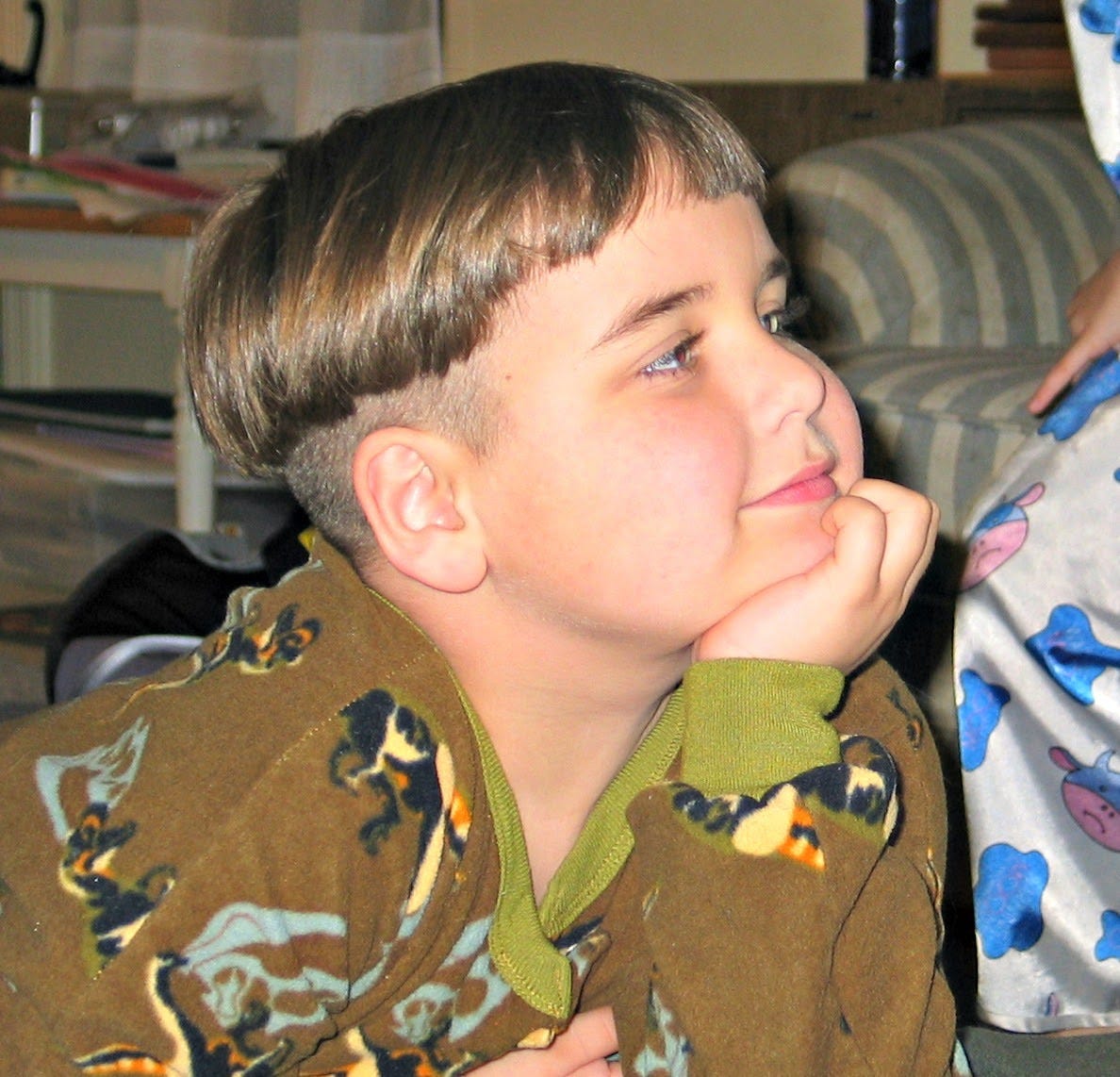
We first realized our now 27 year old son William was different early on. We initially chalked it up to the fact that boys and girls are different. That every kid is different. Not every kid is gonna talk at 9 months like Alex did. It depends on lots of different things.
So we waited. He didn’t talk. Or babble. Or smile. Or do any of that stuff that babies do. He mainly wanted to eat and swing. And swing. And swing.
Willie started therapy groups at 15 months. He was diagnosed with autism when he was 2. There was more therapy. Full day pre-school. Special diets. We sought out and tried almost every therapeutic modality for the treatment of Autism Spectrum Disorder that exists. While all this work has had a positive impact for Willie, he has never really spoken. Certainly not in a way that is readily intelligible to most people, and never consistently. He didn’t potty train until he was 11. He will never live independently.
Having a son who is non-verbal, struggles with physical and emotional regulation, and who will require this level of care was not what I expected. I didn’t really even understand what autism was before we had Willie. Now I have multiple family members on varying parts of the autism spectrum.
Much about this journey has been wonderful. I love my family. I love their quirks. I love the passion and curiosity they have about the world. Our life together has been beautiful.
And. There is also sadness. A grief for what could have been. A grief that must be named and must be managed over time.
I love Willie (and Justin and Liz) more than anything else in the world. And I am grateful for who he is. I also grieve for who he could have been if the wires in his brain had not gotten so jumbled. Who could he have been? Sometimes I miss the kid who wasn’t.
When we talk about grief, we are almost always thinking about heavy, monumental words. Grief, in this formulation, goes with funerals, surprise cancer diagnoses, catastrophic personal or professional failures, divorces, and the end of eras. These are the five-alarm fires of the human heart. They are loud, unmistakable, and easily understandable.
When I was in the hospital, there was an outpouring of support for our family. No one had to be told that what was happening was a big deal. People just got it.
I think we are collectively pretty good at recognizing the big griefs, even as we are often unsure how to support and care for those carrying such grief. And we do what we can to be there for people. We run to where the emergency is and help. That’s a beautiful thing.
What we almost never talk about, though, are the small moments of loss, pain, and struggle. The struggles that come on us unawares. An old memory. A small struggle or challenge. Something like grieving something that wasn’t, or lamenting something that isn’t quite what you hoped. These are griefs, too. And they matter.
I call them micro-griefs. They are the quiet, everyday losses that don’t come with memorial services or casseroles. They don’t leave crater-sized holes in your life. They feel like a splinter in your hand, and they leave tiny nicks on your heart, even when you are unaware. And if you collect enough of these splinters without pulling them out, eventually your entire body begins to ache.
Struggle can look like major loss or unexpected change. But in my experience struggle most often looks like an accumulation of petty annoyances over an extended period of time.
The Paper Cuts of Ordinary Time
One of the goals of Buddhist meditation is to reconcile the distance between what we expect things to be and what they actually are. Try as we might, we almost instinctively have ideas about how things should be. A micro-grief isn’t a crisis; it is one of the ways we fill the space between the way we think things will be and the way they actually are. We are mourning the loss of our expectations.
It’s the realization that your kid has outgrown a bedtime ritual without giving you advance notice. One evening you read a book together, and the next evening they tell you they want privacy. You didn’t know some random Tuesday night was the last time reading the story would happen. Or that this year will be the year they stop asking for hugs in public. Or that, in what feels like a year or two, they’ll get married and soon after that have their own kids.
A micro-grief is the family vacation you spent three months planning and saving for, only to spend the entire week inside a hotel room because someone caught a stomach bug, or had a meltdown about the sand, or because a tropical storm off shore led to constant rain.
A micro-grief is looking at your body at age fifty-four and realizing that the fatigue and soreness and the weight isn’t a temporary thing. It’s just what your body is now. And the body that jumped out of planes and ran without stopping is gone and is never coming back.
It’s watching some of your best and longest friendships quietly drift from weekly phone calls to yearly birthday texts, not out of malice, but through the slow, relentless erosion of busy schedules and physical distance.
None of these events qualify as a disaster. If you tried to call an emergency meeting of your closest friends to announce that your pre-teen wants to walk home from the bus stop now, your friends would probably smile and tell you that’s just how kids grow up.
And they’re right. It is how kids grow up. It is how bodies age. It is how friendships shift. It is how plans change.
Yet dismissive logic doesn’t change the underlying reality: something real ended, something was lost, and a part of you is sad about it.
And that’s okay.
The Compounding Tax of “At Least”
Most of us have a deeply ingrained reflex whenever one of these small aches bubbles up to the surface: we immediately disqualify our own feelings.
We tell ourselves:
“At least everyone is healthy.”
“At least we still have a roof over our heads.”
“At least we have an amazing community.”
“Other people have it so much worse.”
I spent years doing this. In the military, perspective is often used as a weapon against complaining, a weapon I used with my soldiers all the time. “If you have clean water, dry socks, and nobody is shooting at you,” I told them, “then you are technically winning.” While that kind of comparison may be useful for enduring physical challenges during a training exercise, it is a terrible way to manage your emotional life.
Difficulty, after all, is not a zero-sum tournament. The fact that someone else is carrying an eighty-pound rucksack does not mean your twenty-pound pack is weightless. If you run to help someone who has broken their leg and stub your toe, the fact that the broken leg is more serious doesn’t make your toe hurt less.
When you use other people’s tragedies to shame yourself out of feeling your own small disappointments, you don’t eliminate your sadness. You just drive it underground. You add a layer of guilt on top of the original ache. You don’t remove the splinter, you just push it deeper under the skin.
Over time, these suppressed micro-griefs ferment into low-grade irritability, chronic numbness, cynicism, or sudden bursts of anger over trivial things—like losing your car keys or spilling a carton of milk on the counter. You aren’t really screaming about the spilled milk; you are screaming about the six months of unacknowledged losses you swept under the rug.
And it is all compounded by the fact that we don’t give ourselves permission to feel bad for “small” reasons. We pay the compounding tax of ‘at least’.
The Discipline of the Gentle Pause
If we want to prevent micro-grief from hardening into resentment or burnout, we have to learn how to let go in real time. And letting go cannot happen until you first admit that you are holding something.
My amazing therapist taught me to practice what she called the gentle pause. Regardless of its origin, the gentle pause doesn’t require a therapist’s couch or a week-long retreat; it only takes about thirty seconds.
When a plan falls apart, when a milestone quietly slips past, or when an expectation crashes into reality, don’t immediately rush to fix it or put a shiny spin on it. Don’t immediately say “It’s fine.”
Pause. Take one full breath. Name the loss plain and simple.
“I’m really disappointed we had to cancel this trip. I was looking forward to it, and I’m sad.”
“I miss the version of my life where my schedule was my own.”
“I miss how close we used to be.”
You don’t have to set up camp in the sadness. You don’t have to throw a pity party or demand that everyone stop what they are doing to cater to you. You are just acknowledging the data point: This hurts a little bit, and that makes complete sense.
There is a quiet, surprising power in simply telling the truth to yourself. The moment you give yourself permission to feel the sting without judging it, the pressure drops. You don’t have to defend your disappointment; you just let it pass through.
This is how you create space between expectation and reality. This is how you remove the splinter.
Moving with the Current
A river doesn’t fight the bend in its bank. It doesn’t pretend the curve isn’t there, and it doesn’t try to force its way straight through solid rock. It yields, adjusts, and keeps moving downstream.
Life is full of bends. Some are massive waterfalls that completely reshape the landscape, but most are just subtle shifts in the current—daily redirections that ask us to release our grip on what we thought today was going to be.
The art of letting go isn’t about becoming indifferent or pretending that nothing matters. It’s about cultivating enough self-compassion to honor the small losses along the way so they don’t drag you under.
Notice the paper cut. Give it a moment of grace. Then adjust your pack, take the next step, and keep walking. One step at a time. Keep pounding the rock. Soon you will get where you were going.
You will arrive where you were always meant to be. Just as you are.
May it ever be so.
One of your best pieces, Jeff!